Are standard marketing metrics like ROAS (Return on Ad Spend) and third-party attribution models actually helping your business grow, or are they leading you astray? In this webinar, Petri Mertanen and Alain Odijk, CEO and co-founder of the Eyk platform, explain why standard last-click models from Google and Meta are fundamentally flawed and biased.
Using an ice hockey analogy – where last-click attribution mistakenly gives 100% of the credit to the goal scorer while ignoring the assists, they illustrate how relying on third-party platform metrics oversimplifies the customer journey and obscures true performance.
To achieve profitable e-commerce growth, businesses must stop “renting” their data back from ad platforms and start owning it. Watch the full webinar recording below to learn how to implement these first-party data strategies and aim for a 10x return on your contribution margins. 👇
Ready to take ownership of your Ecom data and uncover your true business margins?
Have questions about analytics and attribution challenges? Reach out to Petri directly for a conversation about the issues your business is facing. Interested in seeing the Eyk platform in action? Schedule a demo session with Alain to discuss how Eyk can optimize your e-commerce architecture and drive profitable growth. 👇
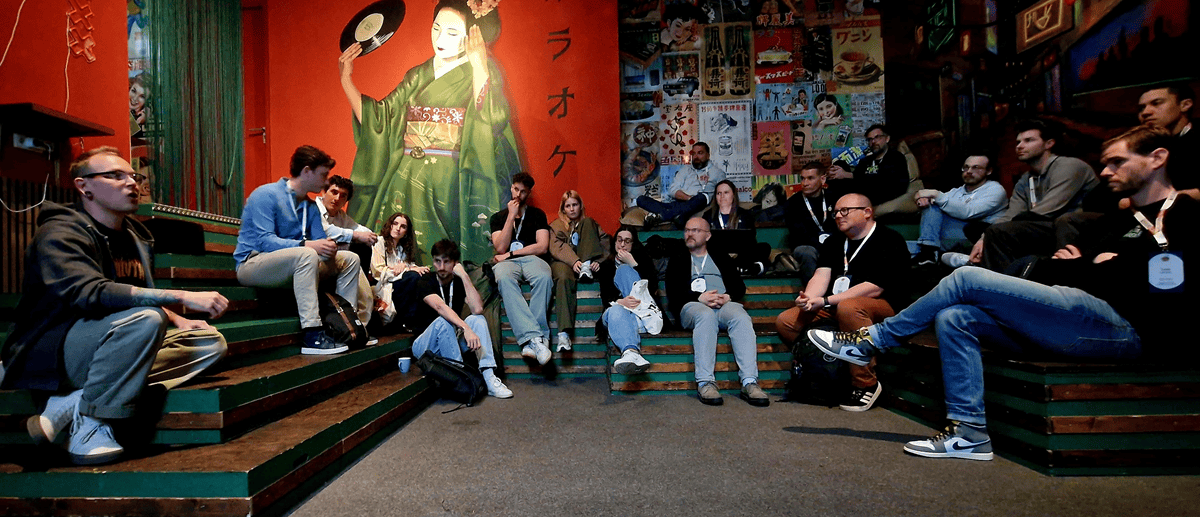
Picture this: You’re at MeasureCamp Amsterdam 2026. Because it’s an unconference, the energy is wonderfully unstructured and buzzing. Tim Ceuppens is up front, giving Google Analytics a bit of a hard time. It’s a classic, unfiltered analytics moment—made exponentially funnier by the fact that Krista Seiden, renowned analytics expert and former Googler, is sitting right behind him. It was hilarious, a little cheeky, and exactly the kind of unvarnished honesty that makes MeasureCamp so great.
But once the laughs settled and the GA4 roasts concluded, a very clear, unavoidable theme emerged. If I had to estimate, more than half of the presentations covered Artificial Intelligence in analytics in one way or another. It is undeniably the number one topic keeping data practitioners awake at night right now. We’ve officially moved past the “hype” phase and are deep into the “how do we actually make this work without business-critical explosions?” phase.
So, whether you were there with me (and maybe missed a session while grabbing a coffee) or you are one of my clients and partners back home in Finland wondering what the European data scene is focusing on right now, I’ve distilled the noise down to the essentials. Here are the 3 hard truths about AI, data, and analytics from MeasureCamp Amsterdam (and DDMA pre event on Friday).
Truth 1: Your AI is only as good as your data governance (and your people)
We all want the shiny AI features, but Marie Fenner from Piano.io dropped a stat that should sober up any eager executive: 95% of AI pilots fail to scale. Why? Because throwing an LLM at a messy database doesn’t magically create insights; it just creates faster chaos. Data privacy (hello, GDPR and the new AI Act) and data governance are no longer just IT compliance checkboxes—they are the foundational pillars of AI. If your data lacks lineage, proper access rights, and semantic context, your AI project is dead on arrival.
But the biggest takeaway from Marie’s session wasn’t about the tech at all. People are the most overlooked ingredient in every AI project. You need transparency, consistency, and repeatability to build data trust within your team. If your people don’t trust the data feeding the AI, they won’t adopt the tools, and that shiny new AI pilot will quietly fade into obscurity.
Truth 2: Perfect data is a myth (so stop chasing it)
If you have ever spent six months building a beautiful business intelligence dashboard only for nobody to look at it, this one is for you. According to Anthony Derrick from Vattenfall, 60-80% of BI dashboards go unused or underutilized. We often build for tool access rather than actual human adoption.
Wouter Nieuwerth from Adwise took this a step further with a brilliant, contrarian take: Your web analytics should be wrong. We waste so much time in analysis paralysis trying to clean up every single tracking bug. But as Wouter pointed out, more accuracy doesn’t equal better data. Every KPI is technically “wrong,” but some are better than others. The real goal isn’t absolute, mathematical perfection—it is reliability and trust.
If your data is imperfect but reliably tracks trends that allow you to make profitable business decisions, you are winning. Accept the imperfection, choose KPIs that actually drive decisions, and match your data complexity to your team’s maturity level.
Truth 3: AI can give you a “beautifully written mistake”
This was perhaps the most profound realization of the day, perfectly articulated by Ibrahim Elawadi from Philips and echoed in Krista Seiden’s presentation. AI is incredibly powerful. As Krista noted, AI can process 10,000 drop-off sessions in 5 minutes—a task that would take a human analyst thousands of hours. The new role of AI is to scan every chart, every hour, and proactively flag anomalies like, “Checkout dropped 15% on iOS.” Teams are already building AI agents (like the ones showcased by Coupler.io) to run entire reporting processes autonomously.
But here is the catch: You cannot trust the answer if the data is poisoned. As Ibrahim wisely stated, AI can generate answers, give you consensus, and provide confidence. What it cannot do is generate doubt about its own framing. It is entirely capable of handing you a “beautifully written mistake.”
The analyst’s job is no longer to build the report or spot the anomaly—the AI will do that. The human’s expert skill is knowing where to look when things go wrong, tracking down the inconsistencies, and applying the one thing algorithms lack: Doubt. The future analyst is a competent, strategic partner who understands business intent, not just a spreadsheet jockey.